
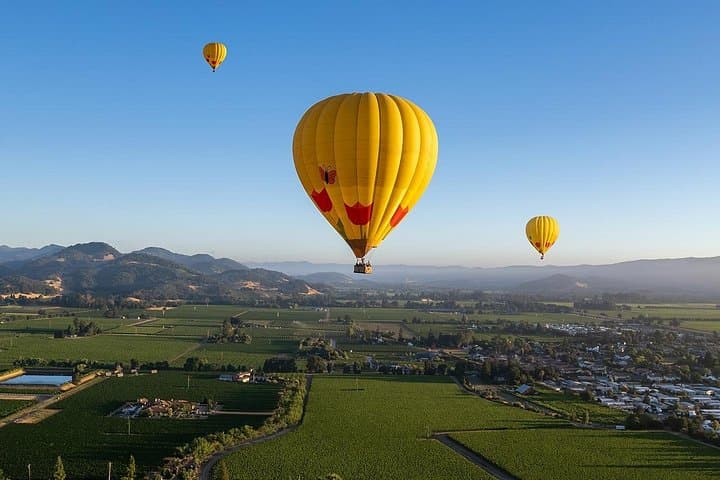
What the day feels like
You step into the basket while the crew tucks the envelope—an enormous, sleeping pet—around the mouth of the burner. The pilot lights the flame and the ragged fabric breathes fire; a hiss, a bright throat of heat, and the valley seems to pause to let you go. Below, rows of vines fold into the morning like a patchwork quilt stitched to the hills; fog retreats from low spots and a pale sun tiptoes along the ridge. For a brief, unhurried hour you are suspended above decades of agricultural history and a landscape so curated for the palate that even the light tastes like harvest.
Hot-air ballooning here is both spectacle and perspective. Napa Valley is a place of microclimates, terraces and terraces of vines, and—if you listen—stories in the wind. The operator for these flights has kept a constant presence over Napa for 45 years, making them as much a part of the valley’s tourism fabric as the tasting rooms themselves. Their daily early-morning launches take advantage of calm pre-dawn air when thermals are minimal, giving you a remarkably smooth, intimate lift over the estates and backroads that make this region famous.
The valley’s geology shapes the experience: rolling hills carved by ancient streams and volcanic soils that help define the flavor of Cabernet and Chardonnay. From the air this becomes legible—benchlands where vines cling to thin soils, river corridors that snake through floodplains, and the dark shoulders of wooded ridgelines. The pilot becomes part meteorologist, part naturalist, naming vineyards, local ridgelines, and the spillways where water breaks through after winter rains. The narrative of place is immediate: pioneer vineyards planted in the late 19th century, Prohibition-era closures, the rebirth of boutique wineries, and Napa’s rise as an American wine benchmark after the 1970s.
Culturally, a morning in a balloon sits at an intersection: romance and ritual, adventure tourism and agricultural pride. You’ll likely land on or near private property where crews coordinate quickly with landowners. Many flights culminate in a sparkling-wine brunch—an old tradition in ballooning that nods to the valley’s effusive relationship with bubbles and hospitality. The operator’s emphasis on safety, local knowledge, and decades of experience means pilots are not just ferrying guests upward; they’re translating landscapes and histories to people who want to connect, not just consume a photo opportunity.
Practicalities are straightforward but matter. The full outing runs roughly three to four hours—early pick-up from town, a 60–90 minute window in the air depending on conditions, and a celebratory landing ritual afterwards. Clothing is conservative: mornings can be chilly even in summer, and while the basket is stable, hot air rises and small steps in and out require sensible footwear. The best time of year for predictable mornings is late summer into fall when high-pressure systems keep dawns calm and clear, though flights run year-round when conditions permit.
For travelers the appeal is threefold: perspective, ease, and ceremony. From above, you glean insights a car can’t give—how a watershed dictates vineyard location, how sun exposure sculpts varietal choice, how clusters of oak and riparian corridors host wildlife. The experience is also accessible to a wide range of ages and fitness levels: you don’t hike to earn the view, you rise. Finally, a post-flight glass—often included—confers a sense of ritual completion that transforms a scenic ride into a memory marked with taste, texture, and local hospitality.
Timing and booking deserve special attention. Mornings are essential: winds pick up and thermals form as the sun warms the valley, and operators schedule flights to coincide with the calmest air. Weather is the only reliable wildcard—trips are canceled for safety when conditions aren’t right. That caution comes with a payoff; when the pilot says go, the valley is often at its most luminous.
If you plan to go, think of this as an immersive introduction to Napa rather than simply an airborne tour. Pair the flight with a tasting visit that afternoon in a small-production winery, or make brunch a longer exploration of local food at Oxbow Public Market or a quiet country table in Yountville. Bring a camera, but also bring a curiosity for the stories your pilot tells: varietal histories, irrigation choices, and family names that recur on estate plaques. These are the threads that tie the aerial view back down to the rows where grapes are still being picked by hand.
A balloon ride in Napa is both spectacle and mentorship—a calm sky offering a fast lesson in why this valley matters to both winemakers and travelers. It’s not a race to the highest altitude but a careful, patient ascent that asks you to look, listen, and then taste what the land has been preparing all year.
Practical snapshot: the experience lasts about three to four hours, includes ground transfers, a typically 60–90 minute airborne stretch, and often a sparkling-wine brunch. Expect early pick-up—often before sunrise—and flexible weather-dependent scheduling. The cost reflects the concierge-style service and the rarity of the vantage point; book ahead, especially during harvest and holiday weekends.
Trail wisdom
Small choices, better day.
Dress in layers
Mornings start cool and warm quickly as the sun rises; layers let you adapt without carrying bulky gear.
Wear flat, closed-toe shoes
A stable sole helps entering and exiting the basket and walking on uneven landing fields.
Bring a compact camera
A small mirrorless or phone with a wide lens captures the scale; secure straps prevent accidental drops.
Plan for early morning pickup
Shuttle times are before sunrise—confirm pickup location and be ready on time to maximize the flight window.
Local knowledge
Read the place, not just the route.
Watch for native species including Red-tailed hawk, Great blue heron.
Keep an eye out for wildlife during the transition between areas and habitats. Respect distance guidelines.
Balloon companies work with local landowners to coordinate landings and minimize disturbance; guests should respect property, avoid littering, and follow crew instructions to protect habitat.
Follow the guide's instructions on size limits, ethical handling, and leave-no-trace practices.
Flyover views of lesser-known family-owned vineyards north of Yountville. Landing proximity to private orchards and historic ranch roads that hint at the valley’s agricultural past
Locally recommended viewpoints and quiet spots known best to local operators.
Napa Valley’s modern wine industry rebounded after Prohibition and gained global recognition in the 1970s; ballooning has been part of its tourism fabric for decades with operators flying here for over 40 years.
Maritime roots and regional tradition shape the waterways and working coasts.
Seasonal guide
Four versions of the same landscape.
Spring
Best forWildflowers · Greening vine rows
ChallengesCool mornings · Occasional rain fronts
Spring brings fresh color and cooler dawns; flights run when mornings are clear but weather can be changeable.
Summer
Best forLong clear days · Stable mornings
ChallengesWarmer afternoons · Occasional smoke from distant fires
Summer offers predictable early-morning conditions—book early in high season for availability.
Fall
Best forHarvest activity · Crisp light for photos
ChallengesHigh demand during harvest weekends · Variable winds post-fronts
Autumn is peak visual season—vine color and activity make flights especially rewarding but popular.
Winter
Best forDramatic skies · Lower crowds
ChallengesCooler, wetter weather · More cancellations due to fronts
Winter can offer moody scenery and quiet mornings; expect a higher chance of weather-related rescheduling.
Pack with intention
What to bring.
Good to know
Common questions.
Flights typically range 60–90 minutes airborne, with the full outing (pickup, flight, landing, and brunch) lasting about 3–4 hours.
Plan the edges
The details that make the day easier.
Napa Valley was designated an American Viticultural Area (AVA) in 1981, formalizing its distinct winegrowing region.
After landing, head to Oxbow Public Market in downtown Napa for artisan coffee and market bites, or book a late tasting at a small-production winery; for a celebratory meal, Yountville’s restaurants (from boulangeries to Michelin-starred tables) are within a short drive.
- Closest major airport
- San Francisco International (SFO) ~1–1.5 hours drive; Driving distance from Napa city center: 10–25 minutes depending on launch site; Cell service: generally good but patchy in rural pockets; Permits: operator coordinates land access and permits—no extra visitor permit typically required.
Balloon flights rely on careful coordination with landowners—pack out any trash, respect private property on landing, and choose operators who follow land-use agreements to protect vineyard and riparian habitats.
Explore by topic
Follow the threads.
Keep exploring
Make the story part of the trip.
Set out from Bass Harbor for a private, customizable day on Blue Hill Bay — lighthouses, puffins, seals, and the chance to feel Acadia from the water. Small groups, local captains, unforgettable views.
In four hours you can move from shaded canyon ferns to wind-scoured coastal ridgelines, guided by someone who knows where the light—and the hidden views—live. This private half-day hike on the Monterey Peninsula or Big Sur is compact, curated, and perfect for travelers who want depth without a multiday commitment.
 Related story
Beneath a sky of shifting light, Skaftafell’s ice reads like a map of time. This three-hour guided glacier hike mixes technical instruction with geology and culture: compact, safe, and unforgettable.